History of Football Game
History of Football Game
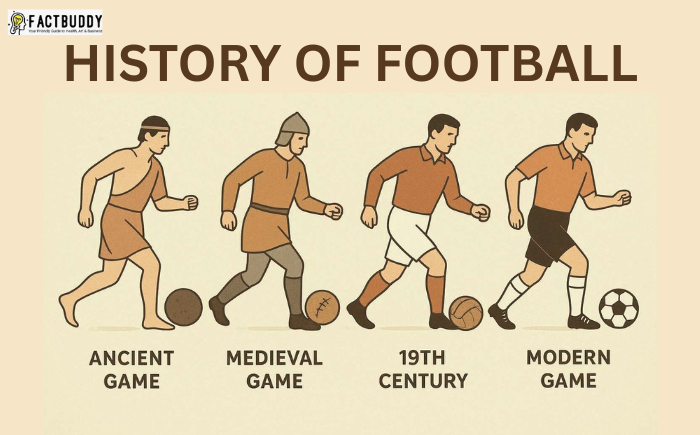
Today, football or soccer is the most popular sport in the world, and the history of football game goes back thousands of years to ancient civilizations. Nearly three thousand years ago, the Maya and Aztecs of Mesoamerica played team games with hard rubber balls, often linked to religious rituals. In China, during the Han dynasty around the 2nd century BC, a game called “Cuju” became popular. Historians consider the leather ball game, where players kicked it into a net, one of the earliest forms of football.
In ancient Greece and Rome, games like “Episkyros” and “Harpastum” were played, mainly to train soldiers physically. At the same time in Japan, a game named “Kemari” was popular, where players passed the ball to each other without letting it touch the ground. In Egypt and parts of Africa too, Archaeologists found evidence of team games using balls made of cloth or animal skins.
All these traditions show that ball games became an important part of culture, sports, and entertainment in different civilizations, which finally paved the way for the modern history of football.
The Birth of Modern Football
The modern history of football began in 19th century England. During this period, the game became very popular in schools and colleges. Each had its own rules—some allowed the use of hands, while others required playing only with the feet. To eliminate this confusion, In 1863, London established the Football Association (FA). Which created the first unified rules. From here, “Association Football” or soccer officially began.
At the same time, some teams supported playing with hands, which gave rise to another sport—rugby. Slowly, the game did not remain limited to England; by the late 19th century, football spread rapidly across Europe, South America, and Asia. English sailors, traders, and expatriates carried football to new countries. This spread gave the game global popularity and marked a new chapter in football’s history
FIFA and the World Cup
To organize modern football on a global scale, FIFA (Fédération Internationale de Football Association) was founded in 1904. Its main aim was to arrange international competitions and establish football as a global sport.
In 1930, Uruguay hosted the first FIFA World Cup in 1930, where 13 teams participated. Host nation Uruguay defeated Argentina in the final to become the first world champion.
Since then, the FIFA World Cup has been held every four years, except in 1942 and 1946 during World War II. Today, the World Cup is the most popular sporting event on earth. Hundreds of countries take part in the qualifiers. A total of 32 teams compete in the final stage, which will expand to 48 from 2026.
The World Cup is more than just a football tournament. It has become a global festival and a symbol of culture, unity, and passion. Billions of fans watch it live, making it the most viewed television event in history.Europe and South America’s Influence
Europe and South America have always played the most important roles in the history of football!
In Europe, club competitions took football’s popularity to a new level. The European Cup, now known as the UEFA Champions League, became the most prestigious club tournament in the world. Legendary clubs like Real Madrid, Barcelona, Bayern Munich, and Manchester United have created unforgettable football history. Europe also became the hub of modern tactics, strategies, and commercialization.
In South America, football is more than just a sport—it is part of culture, identity, and emotion. Countries like Brazil, Argentina, and Uruguay have added unique colors to football. Some of the greatest legends in football history—Pelé, Maradona, Ronaldo, and Messi—were born here. Brazil remains the only nation to have won the World Cup a record five times.
The Copa Libertadores, South America’s premier club competition, is seen as a continental honor, as prestigious as the World Cup itself.
Even today, the rivalry between Europe and South America makes the FIFA World Cup the most fascinating stage in football history.
The Journey of Indian Football
Indian football began during the colonial period when the British popularized the game in Kolkata. During this time, several historic clubs were born. In 1888, people founded Mohammedan Sporting Club, and in 1889, they created Mohun Bagan Athletic Club. Laying the foundation of the history of Indian football.
A milestone came in 1911 when Mohun Bagan defeated the British team East Yorkshire Regiment in the IFA Shield final. It was the first time an Asian team defeated a European side. This victory was not just a sporting achievement but also became a symbol of Indian nationalism.
After independence, Indian football continued to achieve success. Fans and historians often call the 1950s the golden era of Indian football. So India won gold medals in the 1951 (Delhi) and 1962 (Jakarta) Asian Games. In the 1956 Melbourne Olympics, India finished fourth, which remains its best-ever achievement.
Some of the greatest figures in the history of Indian football include legendary coach Syed Abdul Rahim, players like Chuni Goswami, PK Banerjee, Baichung Bhutia, and modern icon Sunil Chhetri—who ranks among the world’s top international goal scorers.
Today, with the Indian Super League (ISL) and I-League, Indian football is regaining its popularity and striving to establish itself on the international stage.
Football in the Present Day
Although cricket remains the most popular sport in India, football is slowly gaining new life. The ISL has brought the sport back into national discussion and increased audience engagement.
At the same time, the younger generation is directly connected to international football culture through European club football and global tournaments like the FIFA and World Cup. As a result, Indian fans are now part of the global football emotion and excitement.
Conclusion:
After thousands of years of evolution, the History of Football Game shows how it grew into the world’s most popular sport. From ancient ball games to modern rules, from the creation of FIFA to the hosting of the World Cup—everything has combined to make football a global festival.
Football history shows that the game not only entertains but also unites people through passion, competition, and a spirit of togetherness.