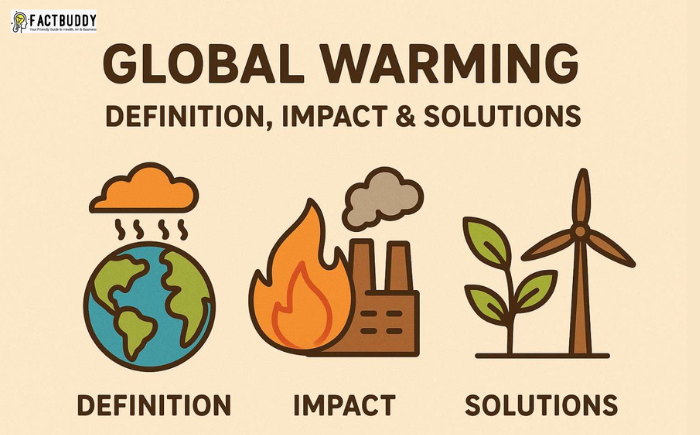
Global Warming: Definition, Impact & Solutions
Today, the Earth is going through a serious problem—global warming. The balance of nature is crucial for the survival of our planet. However, humans’ excessive consumerist lifestyle, industrialization, and negligence toward the environment are disrupting that balance. The Industrial Revolution, which began in the 18th century, propelled humans toward progress, but its negative effects are increasingly evident today. Excessive use of fossil fuels and deforestation are releasing large amounts of greenhouse gases into the atmosphere. These gases trap the Sun’s heat, raising the Earth’s average temperature. This is how the alarming chapter of global warming began.
People often confuse climate change with global warming, but they are different. Global warming is the gradual increase in the Earth’s average temperature, while climate change is the overall shift in weather patterns and seasonal changes worldwide. In simple terms, global warming is the main cause of climate change.
Today, we see abnormal weather, melting polar ice, frequent natural disasters, and severe environmental degradation. All of these clearly indicate that the Earth is heading toward a crisis. Therefore, it is essential to understand how global warming occurs, its real causes, and how much threat it poses to human civilization.
Global Warming Definition and Process
Global warming refers to the gradual increase in the Earth’s average temperature. It mainly occurs due to the greenhouse effect. Normally, sunlight reaches the Earth, warming it, and some of that heat is reflected back into space. But when excessive greenhouse gases accumulate in the atmosphere, this heat is trapped and cannot escape, causing the Earth’s temperature to rise abnormally.
Greenhouse gases include carbon dioxide (CO₂), methane (CH₄), nitrous oxide (N₂O), and chlorofluorocarbons (CFCs). Their primary sources are human activities. Burning coal, oil, and natural gas produces large amounts of CO₂ and methane. Since the Industrial Revolution, the use of these fuels has increased, accelerating the pace of global warming.
Not only fuel combustion, but deforestation is also a major problem. Trees naturally absorb CO₂ and help maintain atmospheric balance. But large-scale cutting of forests leaves excessive CO₂ in the air. Added to this is pollution from factories, smoke from vehicles, and the use of chemicals in agriculture. Together, these factors are causing the Earth’s climate to become progressively warmer.
In short, global warming is a long-term process in which human activities are raising the Earth’s temperature abnormally and disturbing nature’s balance.
Role of Natural Causes
Although human activities are the primary cause of global warming, some natural factors also play a role, such as volcanic eruptions, variations in solar radiation, or changes in ocean currents. However, these effects are usually temporary and far smaller compared to human-induced impacts.
Human-Caused Factors
The main cause of today’s global warming is human activity. Since the Industrial Revolution, excessive burning of fossil fuels—like coal, oil, and natural gas—has produced enormous amounts of greenhouse gases. Deforestation has further increased CO₂ concentration in the atmosphere.
Additionally, smoke from factories and vehicles, and the use of chemical fertilizers and pesticides in agriculture, pollute the environment even more. As a result, the density of greenhouse gases in the atmosphere is rapidly increasing, causing the Earth’s temperature to rise steadily.
Global Warming Effects
The effects of global warming are wide-ranging and pose serious threats to both our daily lives and future generations:
- Extreme weather: Storms, cyclones, floods, droughts, and wildfires are becoming more frequent.
- Melting ice and rising sea levels: Polar ice is melting rapidly, raising sea levels and putting coastal cities and island nations at risk of submergence.
- Loss of biodiversity: Many animal and plant habitats are being destroyed, leading several species toward extinction.
- Health risks: Heatwaves, humidity, and pollution are creating new diseases, threatening human health.
- Economic impact: Droughts, floods, and other natural disasters damage agriculture, fisheries, tourism, and various industries.
These effects are not limited to nature alone—they impact our daily lives, food security, and the survival of future generations. Therefore, the consequences of global warming are extensive and cannot be ignored.
Climate Change and Global Warming
Many people think global warming and climate change are the same, but they are not. Global warming is the continuous rise in the Earth’s average temperature, while climate change refers to long-term shifts in weather patterns, rainfall, and seasons caused by that temperature rise.
For example, excessive rainfall during monsoon or prolonged droughts are effects of climate change. Simply put, global warming is the cause, and climate change is the effect.
Global Warming Solutions
Taking steps to reduce the harmful effects of global warming is crucial. Some effective solutions include:
- Use renewable energy: Increase the use of solar, wind, and hydropower while reducing fossil fuel consumption.
- Energy efficiency: Minimize electricity and fuel wastage by using efficient technologies in homes, transport, and industries.
- Forest conservation and tree planting: Prevent deforestation and plant more trees to absorb CO₂ from the atmosphere.
- Sustainable agriculture and industry: Reduce chemical fertilizers and pesticides and adopt eco-friendly technologies.
- Transportation and personal initiatives: Use public transport, ride bicycles, use electric vehicles, and choose sustainable products to move toward a low-carbon lifestyle.
- Policy and international cooperation: Governments must implement strong environmental policies and follow international agreements.
At the global level, initiatives like the 2015 Paris Agreement aim to limit the global temperature rise to 2°C above pre-industrial levels. Achieving this goal requires the collaboration of governments, industries, and individuals.
Small personal actions, along with large policy measures, are all vital to mitigating.
Conclusion:
Global warming is not just a scientific or environmental issue—it is a major threat to human civilization. If we do not act now, future generations will inherit a planet that is unsafe to live on. Governments, industries, society, and individuals must work together.
The key to saving Earth is to care for nature, adopt sustainable living, and use eco-friendly technologies. We must remember—the Earth is not ours; we are part of the Earth. Glaciers are melting, storms and floods are increasing, and the lives of humans and animals are at risk.
Using renewable energy, conserving forests, practicing conscious agriculture and industry, and taking personal initiatives like planting trees, saving electricity. Even small steps can bring significant change. Earth is our shared home, and protecting it is our collective responsibility. Global warming is not a distant problem—it is happening today and demands immediate action.