What is Madhubani Painting
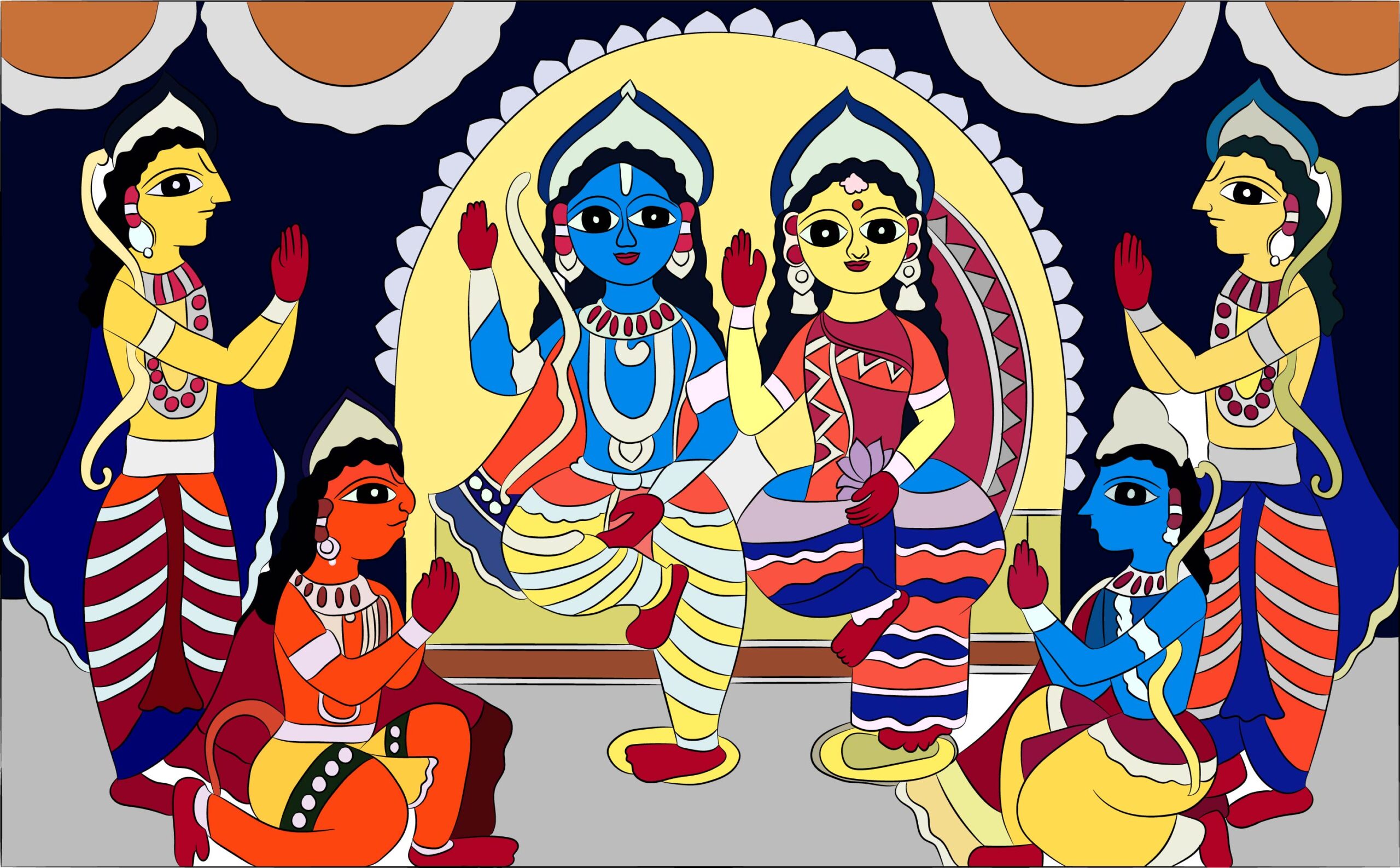
Madhubani painting, also called Mithila painting, is a traditional folk art form. It originated in the Mithila region of Bihar, India, and Nepal, and moreover, it has become an important symbol of the area’s cultural identity.
There is a popular legend about the origin of this art form. Legend says King Janaka, ruler of Mithila and father of Goddess Sita, commissioned artists to decorate his palace walls. The paintings celebrated the wedding of Sita and Prince Rama of Ayodhya.
The name “Madhubani” comes from the Madhubani district of Bihar, which is one of the main centers of this art. Villages like Jitwarpur, Ranti, and Rashidpur are especially famous for preserving and developing the tradition of Madhubani art. For generations, women of the Mithila region have been creating Madhubani painting drawings using fingers, twigs, nib-pens, matchsticks, or brushes, and painting with natural dyes.
Madhubani paintings are known for their colorful geometric patterns. Artists often create them during festivals and occasions like births, weddings, Holi, Chhath, Kali Puja, Upanayana, and Durga Puja. While artists once limited Mithila painting to wall paintings and floor designs (known as bhittichitra and aripana), they now create it on cloth, paper, and canvas as well. Even today, villages like Ranti and its surroundings in Bihar keep this ancient tradition alive.
Origin and Cultural Heritage:
In its early days, Artists drew Mithila paintings only on freshly plastered mud walls and floors of huts. Later, They also created it on cloth, handmade paper, and canvas. Artists made the colors for Madhubani paintings from rice paste and natural substances. For example—red from vermillion and turmeric seed, black from lamp soot and cow dung, white from rice paste, yellow from turmeric, blue from indigo, orange from palash flowers, green from bel leaves, and reddish hues from red ochre.
For binding colors, gum arabic (for paper paintings) or goat’s milk (for wall paintings) was used. From the 1940s onwards, Artists also began using chemical powder colors. Artists would draw with bamboo sticks, rags, or twigs, and even today, many follow the same traditional methods.
Before starting a Madhubani painting drawing, Artists coat the canvas with cow dung and mud to protect it from insects. Then, Artists draw the designs using bamboo pens and natural colors. Madhubani painting designs are known for bright colors, geometric patterns, symbolic imagery, and a style where no space is left empty.
Themes and Meanings:
Madhubani painting often portrays human life, the relationship between humans and nature, and scenes from mythology. Images of deities, natural elements like the sun and moon, and sacred plants such as tulsi are common. Royal court scenes, wedding rituals, and festive celebrations are also popular themes.
Artists fill every part of the painting—empty spaces are filled with colorful flowers, birds, animals, and geometric patterns.
Special features of Madhubani painting designs include:
- Fine and intricate geometric patterns.
- Natural colors—yellow from turmeric, blue from indigo, white from rice powder.
- Symbolic motifs such as fish (fertility), peacock (love), and serpent (protection).
- Hindu mythology, local flora, fauna, and daily life scenes.
- Even application of colors without shading or blending.
- Once only painted on walls and floors, now also on paper, fabric, and canvas.
Features of Madhubani Art:
Mithila painting is one of the oldest and most celebrated art forms of the Mithila region of India, preserved for centuries as a carrier of cultural heritage.
- Keeper of tradition: Passed down from generation to generation, it is an important part of the folk history of Mithila.
- Use of natural colors: Colors are prepared from leaves, flowers, soil, and other natural materials.
- Diverse designs: Geometric motifs, flowers, birds, fish, sun, moon, and various scenes from nature.
- Religious and social messages: Reflects Hindu mythology, rituals, and social customs.
- Women’s creative contribution: Traditionally practiced by women, representing their creativity and cultural identity.
Today, Madhubani art is not limited to wall paintings; it is used on cloth, paper, home décor, and various commercial products. Paintings are usually made with fingers, twigs, brushes, nib-pens, or matchsticks, using natural pigments. Bright geometric style and symbolic motifs are the main characteristics. Each festival or occasion—like birth, marriage, Dol Jatra, Chhath, Kali Puja, Upanayana, and Durga Puja—has its own thematic style.
Types of Madhubani Painting:
There are five main Madhubani painting types—Bharni, Katchni, Tantrik, Godna, and Kohbar.
In the 1960s, upper-caste women artists from India and Nepal, especially Brahmins and Kayasthas, mainly worked in Bharni, Katchni, and Tantrik styles, focusing on religious themes—depictions of deities and spiritual stories. On the other hand, lower-caste artists painted scenes from daily life, local folklore (such as the story of village guardian Raja Shailesh), and symbolic motifs.
Today, there is no caste-based distinction, and all artists work freely in all five styles. Madhubani is famous for its worldwide recognition and unique visual appeal.
Artists traditionally painted the Kohbar style (also called Puren) on the walls of the bridal chamber, where newlyweds spent their first night. This style often features circular motifs centered around a woman’s face, drawn with fine lines in red and black ink. The Kohbar style also has two variations—Brahmin and Kayastha.
Major Contributions:
In the 1960s, Madhubani painting drawing on paper and canvas provided new livelihood opportunities for poor women in the Mithila region.
In 2012, artists also used the art form for environmental conservation in Bihar. An NGO named Gram Vikas Parishad initiated a project to protect local trees. Artists painted images of deities, Radha-Krishna, Rama-Sita, and scenes from the Ramayana and Mahabharata on trees using a mixture of lime, adhesive, and enamel paint to prevent people from cutting them down.
The Self-Employed Women’s Association (SEWA) of Madhubani supported this project. Organizers have featured Madhubani paintings on UNESCO Christmas cards, in museum collections, and in international exhibitions. In 2018, the Asian Art Museum in San Francisco hosted the exhibition “Painting is My Everything: Art from India’s Mithila Region” showcasing this art form.
Famous Madhubani artists include Karpoori Devi, Sita Devi, Jagdamba Devi, Ganga Devi, Baua Devi, Mahasundari Devi, and Godavari Dutta. Women in the Mithila region of Bihar initially used this art to decorate homes, fabrics, and household items.
Prominent Artists and Honors:
The first official recognition of Mithila painting came in 1969 when the Bihar government awarded Sita Devi the State Award. Later, in 1999, the art form received more formal acknowledgment.
The first artist to receive a National Award for Madhubani painting was Jagdamba Devi, honored with the Padma Shri in 1975 by the President of India. In the same year, Sita Devi from Jitwarpur village near Madhubani also received the National Award.
Jagdamba Devi’s foster son, Satya Narayan Lal Karn, and his wife, Mati Karn, gained fame in Mithila painting. They jointly won the National Award in 2003.
Sita Devi received the Padma Shri in 1981, Bihar Ratna in 1984, and the Shilp Guru Award in 2006. Similarly, Ganga Devi was awarded the Padma Shri in 1984, and meanwhile, Mahasundari Devi received the same honor in 2011. Other national award-winning artists include Yamuna Devi, Shanti Devi, and Chano Devi. Bindeshwari Devi, Chandrakali Devi, and Bharti Dayal also received the honor, along with Shashi Kala Devi, Baua Devi, Godavari Dutta, and Leela Devi.
Conclusion:
Madhubani painting is not just an art form—it is a living reflection of the culture, traditions, and creativity of the Mithila region. Passed down through generations, this art has traveled from home decorations to international exhibitions. Numerous artists, through their skill and dedication, have brought Mithila painting to the global stage, winning many awards and honors.
Today, Madhubani art is not only the pride of Bihar but also a treasured cultural heritage of India and the world.